 NEWSLETTER SIGN-UP



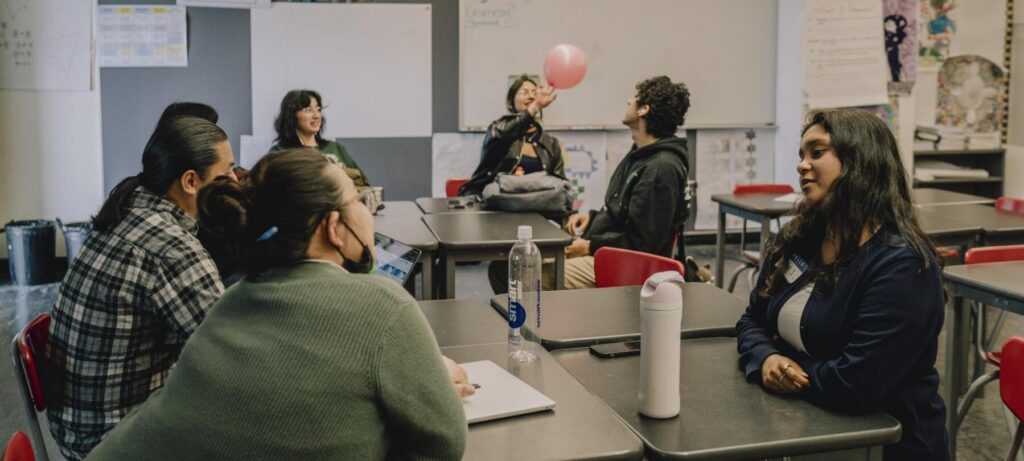
Photos by Isadora Kosofsky/CatchLight for the Stuart Foundation.
Goal setting is a common practice in all schools. However, developing annual goals does not mean that the school–as an organization–has the capacity to reach its goals. This requires that schools intentionally establish both student learning goals and team collaboration goals––and, as an essential step to building capacity, articulate the connections between the goals.
The Importance of Bridging Team and Student Goals
When school plans focus solely on improving student outcomes goals without intentional collaboration practices, teachers and school staff end up working in silos to address goals that require a coordinated, systematic approach. Conversely, when teachers, educators, and staff are focused on improving team collaboration separate from student goals, teams can invest a lot of time and resources into, for example, strengthening transparent decision-making without applying it to improve student learning outcomes or learning conditions. Without clear connections to student outcome goals, efforts to improve team collaboration can drift with the tide of everyday school demands.
The concept of developing explicit connections between student goals and team goals (how educators meet students’ goals) is well established in educational research, particularly in Improvement Science. Improvement Science refers to this process as developing a theory of improvement–a working hypothesis about how to best achieve the aim. The theory of improvement identifies key drivers that impact the aim based on the school’s local context and systems. For example, a school’s aim might be to reduce chronic absenteeism by 10%; the way the staff would meet the goal is through the following key drivers: coordinated supports, engaging learning experiences, and trusting relationships with staff.
In our teacher-powered, student-centered approach to school change and improvement, we propose that educators articulate the connections that meaningfully bridge student goals and team goals. Connection statements articulate how improvement in team collaboration and decision-making builds capacity for the school to address student learning outcome goals. Importantly, a connection statement is not a simple cause-and-effect claim like, “if we improve our meeting structures, then students’ chronic absenteeism will decrease by 10%.” Connection statements push staff to think about how teacher-powered practices create the working conditions to make and implement student-centered decisions that have a positive impact on student learning.
Three Steps to Connecting Team Goals and Student Goals
Setting bold and transformative goals requires collective analysis, discussion, and commitment. A school wide goal developed by one person is a goal that won’t be reached. Here are three steps for designing goals for transformative impact and equity:
First Step: Identify Team Collaboration Goals
The first step is to examine the team’s existing collaborative practices. Teams new to teacher-powered practices can begin by using the Teacher Powered Practices as a reflective guide or by completing the Teacher Powered Survey to receive a free report. Teams already practicing shared leadership and collaboration can create their own surveys for staff. Based on the feedback from team members, identify two to three high-leverage growth areas that can build team capacity. Here are some common growth areas we have seen in schools:
- Develop leadership teams and clarify roles and responsibilities of each team,
- Establish meeting routines such as collective agenda setting, rotating roles, transparent documenting, and collective designing-making.
- Develop a decision-making tree for different types and levels of decisions.
- Establish team norms and common routines for monitoring progress for advancing team goals.
Second Step: Identify Student Learning Goals
The next step is to identify two to three student goals that will guide the work for the year. These goals should be aligned to broader schoolwide priorities while remaining within the team’s scope and purview. For example, a school’s overall goal might be to improve math proficiency based on state assessment results. However, second-grade students may not take the state assessment, so the team of second-grade teachers might create a goal around math proficiency measured by a teacher-created common assessment or based on a curriculum’s unit assessments. Here are some examples of student goals that we have seen:
- Increase percentage of students meeting or exceeding grade-level standards in mathematics.
- Increase percentage of students demonstrating growth in socio-emotional competency of self-management and advocacy.
- Reduce the number of students with chronic absenteeism.
- Increase the percentage of students graduating with college-going plans.
Third Step: Connect Team Goals with Student Goals
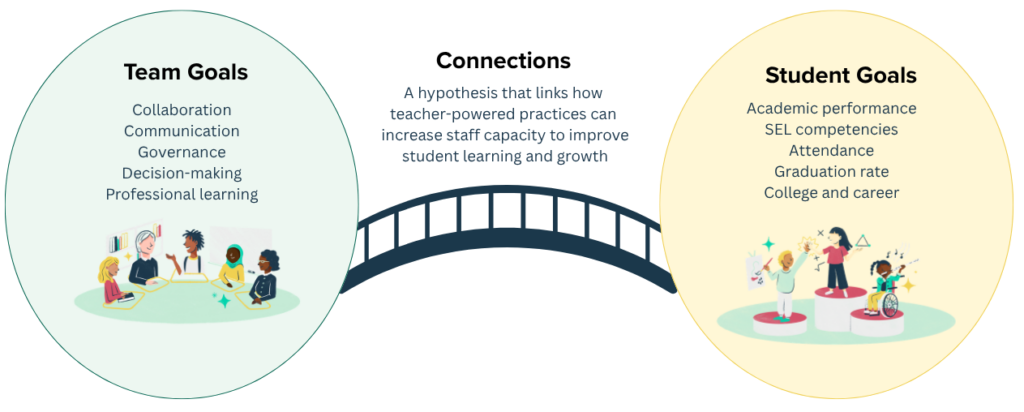
It is essential that this last step is done collaboratively with the team, because the discussion builds shared understanding and collective capacity to improve student goals. This step begins by listing the team’s goal on the left side and the student goals on the right side. Then, teams explore the potential connections between the goals by matching them, considering how improving the team goal might build the team’s capacity to advance the student goal.
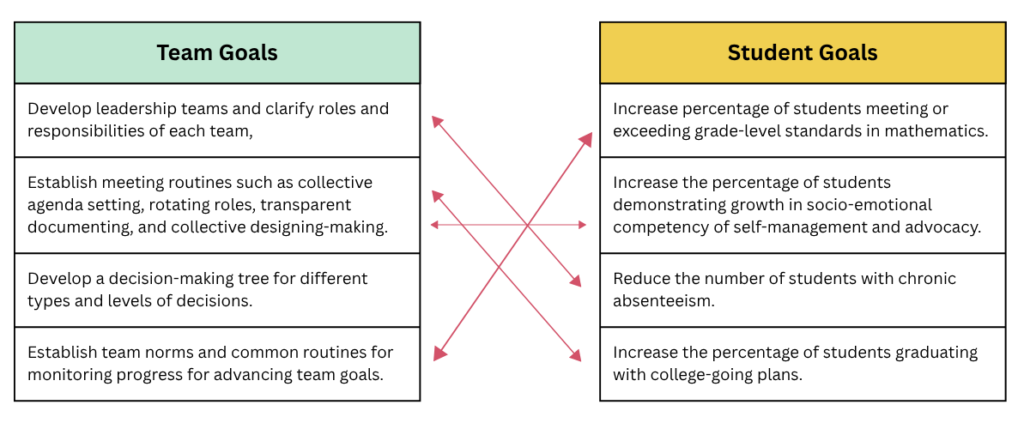
Making connections might not come easily at first, but with some analysis and exploration, teams can get better at seeing the school-site systems that impact student learning and outcomes. There are some questions to help teams explore the connections between team goals and student goals:
- What is impacting our ability to meet the student goal?
- Which changes to our team practices can help us meet our student goals?
- What high-leverage changes to our team could build our capacity to meet our student goal?
Teams should generate as many possible connection statements as possible using this frame:
When we improve [team goal], then we build our capacity to [student goal].
Then, teams should identify one or two goals to guide the team’s work throughout the year. This process helps the team articulate a hypothesis of connection that explains how strengthening team capacity (highlighted in green) can improve student outcomes (highlighted in yellow). Here are some possible connection statements:
- When we establish effective meeting routines that devote time to creating support plans for students with high absenteeism, then we build our capacity to reduce the number of students experiencing chronic absenteeism.
- When we develop a decision-making tree for different types and levels of decisions around our college-going program and supports, then we build our capacity to coordinate supports to increase the percentage of students graduating with college-going plans.
- When we establish team norms and common routines for monitoring progress of students’ mathematic learning, then we build our capacity to increase the percentage of students meeting or exceeding grade-level standards in mathematics.
Schools are busy places, so spending time to identify team goals and make connections with student goals may feel like a waste of time. However, the work of transforming schools for equity requires teams to go slow to go fast: first building a shared understanding of their goals, and then moving with urgency toward improvement. Connection statements also provide teams with a shared point of reference to pause and refocus throughout the year, ensuring that teams are building student-centered schools.