 NEWSLETTER SIGN-UP



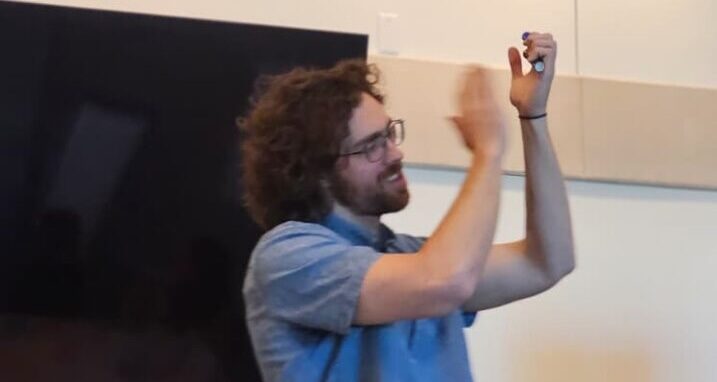
In March 2026, I had the privilege of attending and presenting at the Student Power Summit in Los Angeles. The conference was electric. Students, teachers, and administrators together, exploring student agency, and asking real questions about how power works in schools. It was genuinely inspiring to witness and be a part of.
And throughout the conference, a question kept surfacing: what’s the work that adults need to do alongside this? Because students can feel it when the adults in the room haven’t done their own work. They always can.
That question is exactly where teacher power comes in.
Standing in that room, I was also holding my identity as a Teacher-Powered Schools (TPS) Ambassador. On the surface those might seem like different worlds. But I kept coming back to the same thought: they’re two sides of the same coin. One without the other leaves something essential on the table. I learned this, as most good lessons arrive, the hard way.
Starting With Students (And Getting It Wrong)
At a startup charter high school in Michigan, student agency wasn’t just a value. It was a core pillar, baked into how the school described itself. And we took it seriously. We launched student governance through consensus-based all-school meetings. Forty or fifty people sitting in circles, trying to make decisions together.
It was well-intentioned. It was also unwieldy, frustrating, and if I’m being honest, more than a little performative. The students were trying. We were trying. But we didn’t really know what we were doing, and it showed.
It was well-intentioned. It was also unwieldy, frustrating, and if I’m being honest, more than a little performative. The students were trying. We were trying. But we didn’t really know what we were doing, and it showed.
Then I came across School Circles, a documentary exploring sociocracy in democratic schools in the Netherlands. It cracked something open. Inspired by what I witnessed there, we began implementing democratic circles, consent-based decision-making, and structured rounds with our students. Sociocracy, at its core, is a way of making decisions together that’s both inclusive and efficient: structured enough to actually work, flexible enough to adapt. The tools got better. Student participation became more meaningful, more manageable.
But something was still off.
The Piece We Were Missing
Our adult team wasn’t practicing any of this ourselves.
We were facilitating democratic participation with students while continuing to operate as adults in a fairly conventional top-down structure. The dissonance was real, even when we couldn’t quite name it.
After pushing for this for some time, there was finally a moment where we, as a team, decided to give it a shot in our own meetings too. Slowly, awkwardly, and with more than a little resistance from all of us, we began practicing shared decision-making as adults.
It didn’t happen overnight. It required real practice, real patience, and a willingness to sit with the discomfort of sharing power in new ways.
It didn’t happen overnight. It required real practice, real patience, and a willingness to sit with the discomfort of sharing power in new ways.
But once it took root? Everything changed.
One educator who lived through that journey later reflected: “When I understood the benefits and opportunities of sociocratic decision making, it was a paradigm shift: changing my reality to see that group decision making can actually be all inclusive, gratifying and enjoyable.”
Our staff meetings stopped being information-sharing sessions and became generative spaces. We got better at navigating hard conversations, more creative in our problem-solving, more aligned in shared purpose. And our work with students became dramatically more authentic, because we weren’t just facilitating democratic practices anymore. We were living them. Students could sense that, and it changed how they showed up too.
The Pattern Holds
I’ve seen this in other contexts too. As director of a microschool serving students from kindergarten through eighth grade, I stepped into a community with some existing democratic practices already alive in it. Over time, we worked together to deepen them, bringing shared decision-making tools to both our adult team and our students, and at times finding our way into practicing together around real school decisions. When the whole organization held it, not just in student programming but in how the adults governed themselves, something different emerged. Not always efficient. Not always easy. But real. Students felt ownership over their education and their school in a way that’s hard to manufacture any other way.
Both schools, at very different grade levels, are still practicing this today, with adults and students. That matters.
Both. Together.
TPS schools are built around student-centered learning. What these stories suggest is that student agency, real ownership over learning and a genuine voice in how things run, might be what makes that centering stick.
Student agency can exist without teacher power. Teacher power can exist without student agency. But when both are practiced together, something different happens. Each one amplifies the other.
In the TPS guide “Collaborative Leadership for Thriving Teams,” a great resource for any team navigating this work, Buffy Cushman-Patz, Founder of SEEQS in Honolulu, calls it parallelism: structures that work at one level of an organization work at all levels. The research backs that up: positive places for educators to teach and lead become productive places for students to learn and grow. And when that cycle is really working, students aren’t just learning in an empowering environment. They’re helping to build it.
So here’s what I find myself wondering: if your team has built real collaborative leadership structures, what would it look like to extend that same practice into student governance? And if student agency is already alive in your classrooms, where are the adults doing that work alongside them?
Many schools are already living this. Teacher power AND student power, practiced together, held by everyone. That’s the school worth building.