 NEWSLETTER SIGN-UP




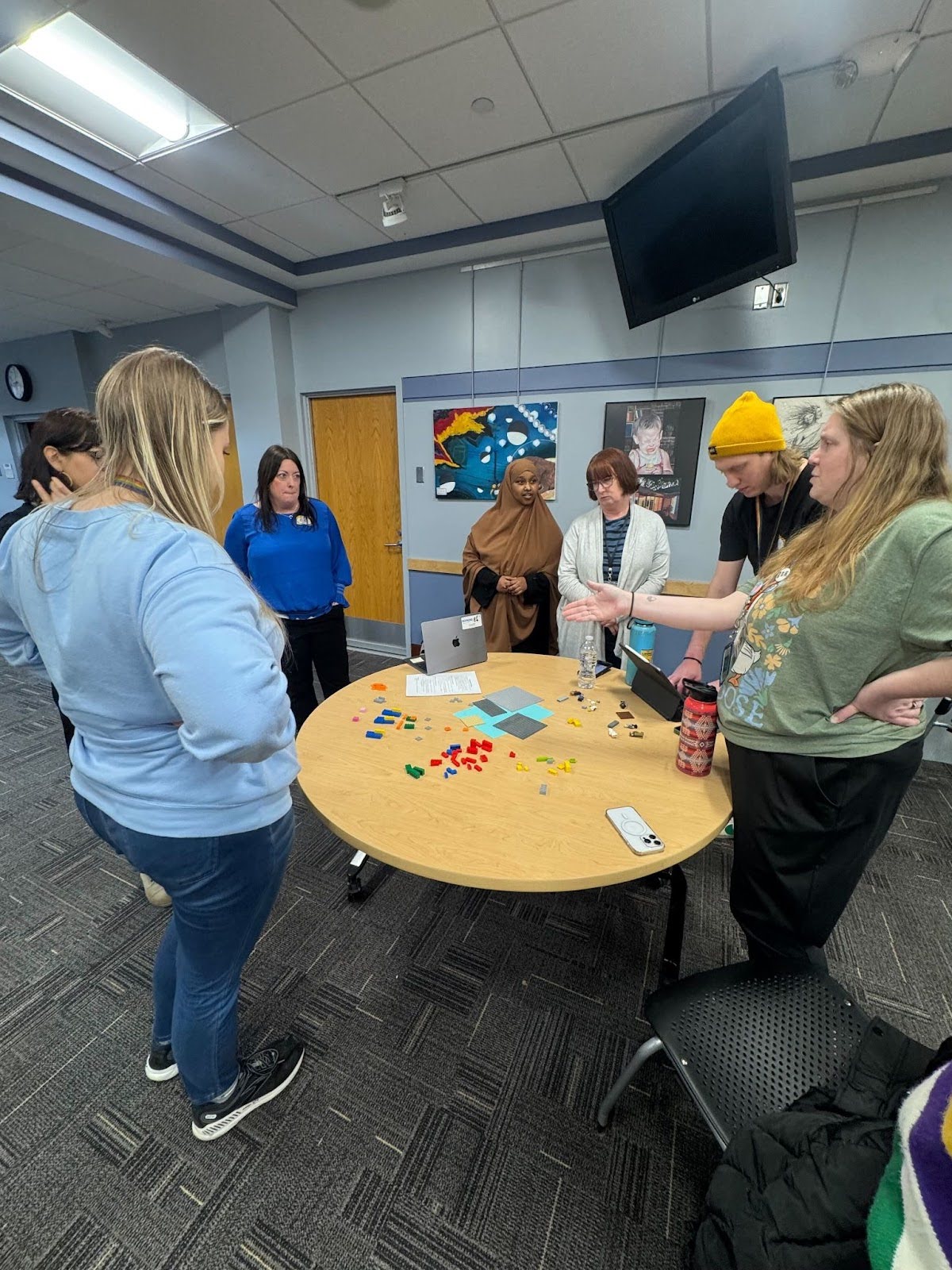
Photo Caption: Hopkins School District, The Prism Challenge Co-Design Workshops (2025–2026)
Community. Connection. Belonging. These are essential conditions for learning and teaching well. Yet for too long, schools have been organized around a one-teacher, one-classroom model that isolates educators and falls short of meeting the diverse needs of students.
Co-design offers a different way forward. It brings educators out of silos and into shared leadership through school-based design teams composed of classroom teachers, specialists, paraprofessionals, and administrators. Together, these teams co-create staffing models, co-teaching strategies, schedules, and leadership structures that reflect their local context and the strengths of their community.
This work is taking shape through the Prism Challenge, a three-year pilot in partnership with TPS and Empower Schools and part of Teach Plus’s Center for Inspired Teaching, Exceptional Learning project. Our premise is simple but powerful: when educators are trusted and empowered to lead and adapt, schools become more effective, equitable, and fulfilling places to teach and learn.
When educators believe in their collective ability to make a difference, student outcomes improve. Research refers to this as collective efficacy, and co-design creates the conditions for it to flourish. Through this process, teams move away from isolated routines and toward deeply connected, community-centered structures. This shift is not symbolic. It requires intentionally reconfiguring roles, responsibilities, and decision-making authority at both the school and system levels so that teachers are not merely implementing change, but leading it.
These conditions matter. By reducing isolation and strengthening coherence, co-design helps combat burnout, supports educator retention, and enables stronger, more integrated instructional systems.
This month, three Minnesota school teams gathered for a retreat to synthesize their work during a particularly tumultuous school year. More than ever, they needed the strength of their collaborative communities. Using a design-thinking approach, teams engaged in empathy-building, problem definition, bold ideation, and rapid prototyping. Whether using Legos to visualize shared rosters or sticky notes to map innovative schedules, teams physically manipulated the variables of time, staffing, and instruction to discover what works.
At the heart of this work is a commitment to building community, connection, and belonging in every classroom. Teams are designing shared rosters where general education teachers co-teach alongside special education and English learner teachers who push into classrooms to deliver instruction aligned to students’ needs. This approach enables immediate, high-impact Tier 2 interventions without isolating students from their peers.
By delivering inclusive instruction within shared learning environments, schools begin to dismantle the stigma often associated with pull-out models and separate settings. Students who have historically been underserved by rigid structures instead experience learning environments built around their strengths and needs, supported by teams of educators who are empowered to innovate on their behalf.
At its core, co-design leads to stronger and more equitable teaching and learning because it taps into the creativity, expertise, and commitment already present within school communities.
To meet the challenges of modern education, we must stop searching for silver bullets and start trusting the experts in our classrooms. We must view teacher roles through a new prism—one that reflects our collective assets, knowledge, and experience. When we co-design, we do more than improve schools. We reimagine what is possible for every learner and every leader within them.